Nesting Toys

    View as

    Shape sorters (ألعاب التركيب) are among the first educational toys recommended for babies and young children. From the very first months, children seek to understand the relationships between objects: why does this shape fit into this hole and not another? This natural curiosity is exactly what shape sorters, peg puzzles, and activity cubes stimulate. By manipulating, inserting, and repositioning the pieces, children develop their fine motor skills, hand-eye coordination, and concentration — fundamental skills that support later school learning.

    The choice of material plays an important role in the durability and safety of the toy. Natural wood, non-toxic and robust, remains the benchmark for sorting toys intended for toddlers: it resists impacts, does not warp under heat — an essential criterion in Moroccan homes during summer — and its pleasant texture offers additional sensory stimulation. Quality plastic or soft EVA foam models complete the range for specific uses like bath toys or interlocking play mats. In all cases, checking for the absence of small detachable parts and compliance with safety standards remains essential before any purchase for a child under 3 years old.

    Moroccan families favor toys that combine several types of learning in a single activity: a pull-along truck that integrates a shape sorter, a multi-activity cube that encourages the recognition of colors, numbers, and shapes, or even a sound puzzle that associates an image with a corresponding sound. These versatile formats offer a longer lifespan because children return to them at different stages of their development, discovering a new level of play each time. This is both a practical and economical approach to creating an educational playroom at home, adapted to the rapid evolution of young children between 6 months and 5 years old.

    The Wlidaty selection covers all formats of shape sorters and peg toys, from the simplest to the most elaborate:

    • Simple shape sorter (from 6–12 months): A cube or box with openings of different shapes where the child inserts the corresponding blocks — the great classic of early development, fostering logic and perseverance.
    • Peg puzzle with large knobs (from 12 months): An illustrated board with thick pieces equipped with a grip knob, easy to grasp for small hands still developing.
    • Themed wooden block puzzle (from 18 months): Animals, vehicles, geometric shapes — each raised piece fits into a specific slot, training visual recognition and precision of movement.
    • Hammering toy (from 12 months): The child hits colored pegs or balls to push them through a support, combining controlled force, coordination, and immediate satisfaction.
    • Multi-activity cube (from 18 months): Each face offers a different activity — sorter, maze, gears, abacus — for complete stimulation and long play sessions without boredom.
    • Wooden alphabet and number puzzle (from 18 months–3 years): Letters and numbers to fit into an illustrated board, providing a first playful approach to reading and math long before starting school.
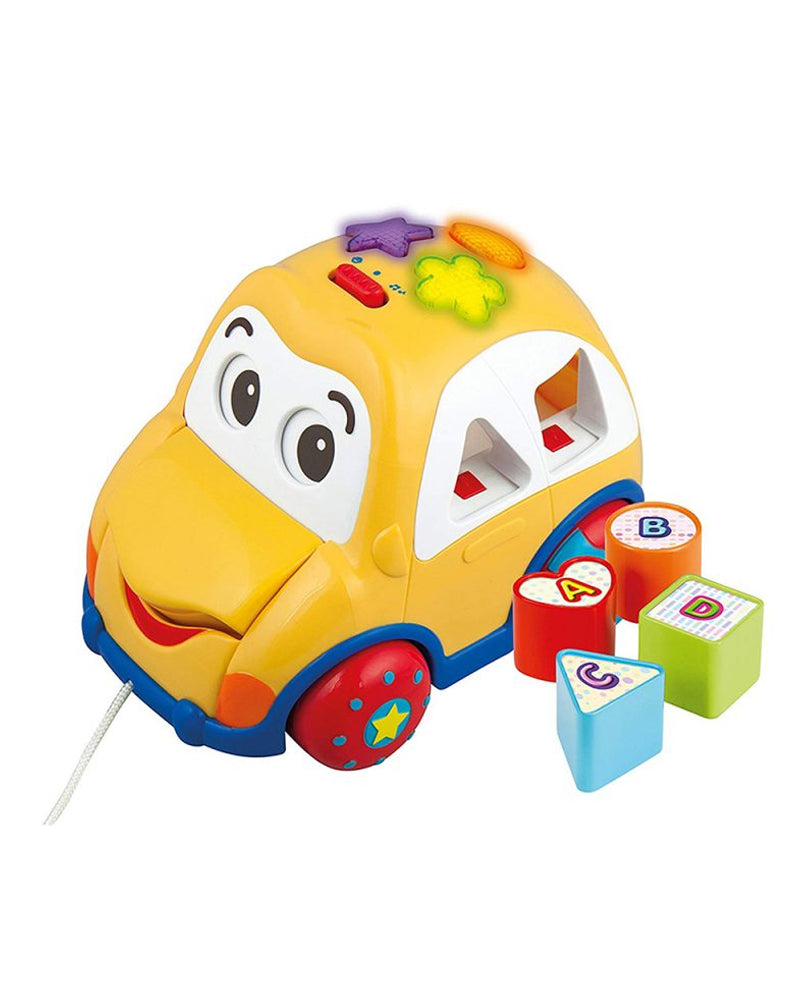
    • Pull-along shape sorter (from 12 months): Combines the fun of movement with an integrated sorter on top — ideal for children starting to walk and explore their environment.
    • Mosaic and pegboard games (from 2–3 years): The child inserts colored elements into perforated cards to create visual compositions, stimulating creativity and fine motor precision.

    A few practical tips for choosing and using shape sorters daily:

    • Strictly follow the recommended ages on the packaging: a toy with small parts designed for 3-year-olds poses a real choking hazard for an 18-month-old, even under supervision.
    • Introduce puzzles in increasing order of complexity: start with 3–4 large piece sorters before moving to 9 or 12-piece puzzles to keep the child motivated without discouraging them.
    • Regularly clean wooden pieces with a slightly damp cloth (without soaking) to preserve non-toxic paints and prevent wood swelling, especially in air-conditioned rooms where dry air can weaken joins.
    • Store pieces in their board or box after each use: an incomplete puzzle quickly loses its educational interest, and isolated small pieces pose a danger to babies in the house.
    • Rotate the toys presented to the child rather than leaving everything accessible at once: reintroducing a toy put away for a few weeks often sparks renewed interest and a new way of playing.
    • For hammering toys, prefer play surfaces placed on a thick rug or a stable table: repeated vibrations on hard tile can damage wooden pieces faster and create unpleasant noise in apartments.

    How do I choose a shape sorter adapted to my baby's age?

    Before 12 months, toys with large openings and easy-to-grasp blocks are ideal. Between 12 and 24 months, knob puzzles and simple shape sorters work well. From 2 years old, children can tackle themed multi-piece puzzles and more complex multi-activity cubes. The key is to progress gradually without skipping steps.

    Is wood really safer than plastic for sorting toys?

    A certified wooden toy, painted with non-toxic inks and without sharp edges, is just as safe as a quality plastic toy. Wood has the advantage of being more durable over the long term and does not warp under heat, which is appreciated in the Moroccan climate. The determining criterion remains, above all, compliance with safety standards, regardless of the material.

    At what age can a child play alone with a shape sorter?

    Before 18 months, adult supervision is recommended, even with toys designed for toddlers, especially for models including removable parts. Between 2 and 3 years, children develop enough autonomy to play alone with simple puzzles. The presence of an adult remains beneficial to encourage, praise, and maintain motivation during learning phases.

    How to maintain wooden puzzles and shape sorters in Morocco?

    Avoid prolonged exposure to direct sunlight, which can fade paint and cause the wood to warp. Clean pieces with a damp cloth without harsh detergents, then dry immediately. In case of slight roughness on the edges, a very fine sanding with fine-grit sandpaper is enough to make the pieces smooth and pleasant to handle again.

    Can a shape sorter really help my child's cognitive development?

    Yes. By looking for the match between a piece and its slot, the child utilizes visual memory, spatial logic, and the ability to anticipate the result of a movement. These mechanisms are directly linked to problem-solving skills and mathematical thinking that will be required upon entering kindergarten (الروضة).

    What is the difference between a shape sorter and a peg puzzle?

    A shape sorter asks the child to identify and insert blocks into corresponding shaped openings, often in a cube or closed box. A peg puzzle features a flat board where illustrated pieces fit into specific slots. Both work on shape recognition but with different movements and difficulty levels.

    Moroccan parents frequently search for these terms to find shape sorters:

    • baby shape sorter Morocco
    • wooden peg puzzle child Morocco
    • baby shape sorter price Morocco MAD
    • best educational toy baby 12 months Morocco
    • cheap wooden puzzle child Morocco
    • baby multi-activity cube Morocco
    • wooden baby hammering toy Morocco
    • Montessori sorting toy child Morocco
    • baby shape sorter quality comparison
    • wooden alphabet number puzzle 3 years Morocco
    • infant fine motor development toy Morocco
    • safe non-toxic wooden sorting toy

    Other expressions and semantic variations frequently used by families regarding sorting and development toys:

    • how to choose a shape sorter by age
    • wooden baby puzzle fine motor skills reviews
    • cleaning and maintaining wooden baby toys
    • Montessori sorting game home Morocco
    • educational newborn gift idea
    • shape color sorter early learning
    • pull-along toy with baby walker sorter
    • wooden farm animal sound puzzle child
    • baby activity cube hand-eye coordination
    • non-toxic paint wooden toy baby safety
    • spatial logic sorting preschool kindergarten
    • wooden educational toy 1 year 2 year birthday gift

    Whether it's a first shape sorter for a 6-month-old baby or an alphabet puzzle to accompany a child toward reading, the sorting toys in the Wlidaty selection are chosen for their manufacturing quality, real educational value, and adaptation to the needs of Moroccan families. Browse the available selection or ask our team for advice to find the ideal toy according to your child's age and developmental stage.