Learning to walk is a fascinating and emotional stage in a child's development (tarbia - تربية). In Morocco, where family homes often have large tiled living rooms, parents look for safe solutions to encourage this burgeoning autonomy. Our collection of walkers and push toys is rigorously selected to support babies during this crucial transition. This equipment does more than just support physical balance; it boosts the child's self-confidence as they suddenly discover the possibility of exploring their environment standing up, at their own pace.
Psychomotor development is not limited to walking. Most of the models we offer are evolutionary and include interactive activity centers. Even before knowing how to stand, the child can sit in front of their toy to manipulate gears, listen to melodies, or sort shapes. This versatility is a major asset for parents looking to invest in durable equipment. With fair prices in MAD, these items offer exceptional value for money, as they accompany the infant's evolution from 6 months up to 3 years old (from floor play to running).
Safety is the central pillar of our childcare offering. Aware of the legitimate fears associated with first steps, we prioritize equipment equipped with wide anti-tip bases, wheels with adjustable brakes, or non-slip rings. Whether you opt for a classic baby walker with a seat or a wooden walker, each product is designed to cushion shocks and slow down the pace if baby gets carried away. Give your child the freedom to move while ensuring your total peace of mind during their daily explorations.
Different equipment to support walking
Our range includes several types of devices, each responding to a specific stage of your child's motor development:
- The Baby Walker (Walker with seat): Generally usable from 6 months, it allows baby to sit comfortably and move forward by pushing on their toes. Ideal for strengthening legs safely.
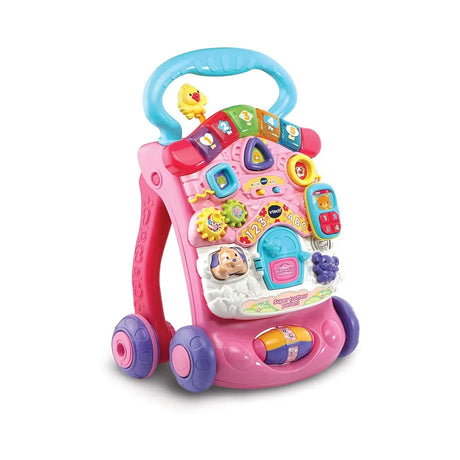
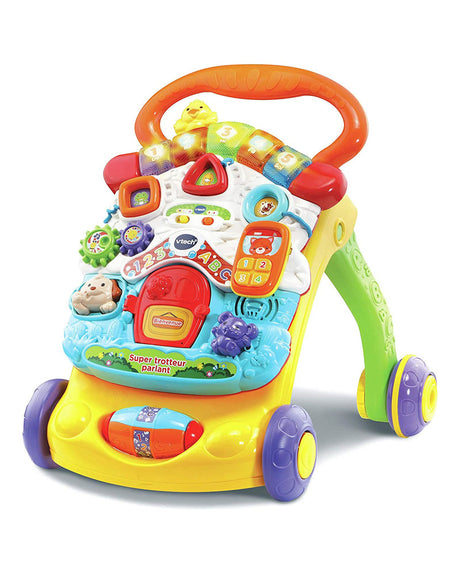
- The Walker (Wooden or plastic push toy): Designed for children who already stand up (around 10-12 months). They grip it to stabilize their first autonomous steps.
- The 4-in-1 (or 5-in-1) Activity Center: Ultra-evolutionary equipment that transforms over the months: floor play, walker, push toy, and sometimes even a small balance bike.
- The Ride-on (snail or animal type): Once walking is well acquired, the child sits on it and pushes with their feet to move throughout the house.
Tips for supporting first steps safely
To ensure that learning to walk remains a joyful and safe game, here are the recommendations from our childcare experts:
- Secure the environment: Before letting baby use their push toy, block access to stairs with a gate, move fragile objects away, and protect the corners of your coffee tables.
- Adjust the height (for Walkers): The seat must be adjusted so that the child touches the ground with the soles of their feet, but not with their legs completely bent, so as not to strain their hips.
- Control the speed: On very smooth floors (tiles, marble), prioritize push toys whose wheels are equipped with non-slip rubber strips or a braking system to prevent the toy from moving too fast.
- Limit usage time: The walker is an excellent early learning activity, but its use should not exceed 20 to 30 minutes per session to encourage the child to experiment with other postures (such as crawling).
FAQ: Everything you need to know about walking equipment
At what age can my baby start using a walker?
The walker (with seat) can be introduced as soon as the baby can sit up alone and hold their head well, generally around 6 months. However, the maximum weight indicated by the manufacturer (often 12 kg) must be respected.
What is the difference between a baby walker and a push walker?
The walker supports the child's weight thanks to a fabric seat, ideal before acquiring a standing position. The push walker, on the other hand, requires the child to already know how to stand up alone to lean on it and roll it in front of them.
Is a wooden push walker better than a plastic one?
Both have their advantages. Wood is ecological, very stable due to its weight, and often aesthetic. Plastic is lighter, easy to clean, and often allows for the integration of electronic functions (lights, music).
How do I slow down a walker if my baby goes too fast?
Many recent push walker models are equipped with a tightening system on the rear wheels (friction brakes). You can thus tighten the rotation of the wheels at the beginning of learning, then loosen them when the child gains confidence.
Are the activity centers detachable?
Yes, on most of our interactive plastic push walkers, the activity board (bead maze, piano, shapes) can be detached. This allows baby to play on the floor comfortably even before having the strength to stand up.
Keywords most searched by parents
To find the ideal equipment, many Moroccan families use these queries:
- Baby push walker Morocco
- Baby walker 6 months price
- Wooden baby walker
- 4 in 1 evolutionary walker
- Best walker to help with walking
- Buy interactive musical walker
- Balance bike ride-on child 1 year
- Walker with safety brakes
- Baby walker comparison
- Height-adjustable walker
Related searches and semantic variants
To deepen their knowledge, parents also explore these themes:
- How to encourage baby to walk
- Review of push walker with braked wheels
- Machaia l'wlidat safety
- First birthday gift idea
- Motor development toy 9 months
- Wheel protectors for tiled floors walker
- Difference between walker and ride-on
- Motor skills development 1 year old child
- Detachable activity board baby
- Securing the house for walking baby
In conclusion, for unforgettable first steps
Accompanying your child's first steps is a magnificent adventure that deserves the best equipment. By choosing a walker or push toy from our vast collection, you offer your baby (tarbia) reliable, stimulating, and totally secure support. At Wlidaty, we make it a point of honor to offer durable solutions that grow with your children, promoting their autonomy and awakening their curiosity at every new stage of their motor development.

 Français
 English


 🔥Only 1 left749.00 MADUnit price /Unavailable


 🔥Only 1 left


